We are happy to be able to re-post an article written by Friend of the Site Anthony Elghossain regarding the current turmoil in the Middle East. The article, originally posted January 26th, can be found on Anthony's blog here.
In 2005, millions of Lebanese marched for their freedom. The streets of Beirut captured the world’s attention and seemed likely to trigger a wave of Arab democratization and reform. But despite glimmers of hope in Iraq, Lebanon, and Syria, the much-lauded “Arab Spring” soon fizzled out.
In some countries, homegrown activism was absent or fell short of a critical mass. In other places, foreign support was inadequate or insincere. Even the Bush Administration, which publicly adhered to a “freedom agenda,” could ill-afford widespread democracy promotion. After all, authoritarian regimes of one stripe or another governed – and still govern – strong American allies like Saudi Arabia, Egypt, and Jordan. In not-so-friendly countries like Syria or Libya, fears of an Islamist wave or civil strife kept Western democracy promotion at bay.
1.31.2011

The Arab Summer: US Policy in the Face of Middle East Turmoil
The leadership of the US has some difficult decisions to make regarding the current turmoil in the Middle East. On the one hand, and in the name of maintaining a status quo of stability in the region, policy has long dictated supporting rulers who have a less than a stellar track record when it comes to supporting democracy and the will of the people. On the other, certainly emphasized under Bush, but maintained as an ideal for some time before that and since, is the idea that democratic forces should guide the political, legal and economic development of nations, both in the Middle East and elsewhere.
These notions are not as incongruous as they may on the surface seem, at least not when you add in another factor; though the US verbally promotes democracy it is often the case that the 'voice of the people' in foreign nations and Arab states in particular does not exactly mesh with the policy goals of the US. Therefore, a more accurate depiction of US policy might be, 'We want democracy abroad, but the kind of democracy we have. And, if not that, then rulers (even if they happen to be strongmen) who promote our interests are a second best.'
These notions are not as incongruous as they may on the surface seem, at least not when you add in another factor; though the US verbally promotes democracy it is often the case that the 'voice of the people' in foreign nations and Arab states in particular does not exactly mesh with the policy goals of the US. Therefore, a more accurate depiction of US policy might be, 'We want democracy abroad, but the kind of democracy we have. And, if not that, then rulers (even if they happen to be strongmen) who promote our interests are a second best.'
Mashups: Should Innovation Excuse Infringement? (Part 4 in a Series)
In this post, the fourth and final in a short series, Frank Gonzalez continues to look at some of the legal issues surrounding one of the latest trends in popular music, the mashup. Part 3, which explored courts' analysis of the fair use exception, can be found here. Today, Frank summarizes the issues and offers some concluding remarks.
The stated purpose of copyright is to “promote the Progress of Science and useful Arts.” 1 Now, whether the combination of Neil Diamond, Nirvana, Willow Smith, Devo 2 and others is the type of progress the Framers were considering is subject to varied interpretation. Regardless of one’s particular opinion, mashups’ innovation and corresponding ubiquity are undeniable. Mashups are in clubs, YouTube pages, and iPods around the globe. Their appeal even intrigued Pittsburg Representative Mike Doyle, who asked Congress to consider that “maybe mash-ups are [a] transformative new art that expands the consumers experience and doesn't compete with what an artist has made available on iTunes or at the CD store.” 3
Conclusion
The stated purpose of copyright is to “promote the Progress of Science and useful Arts.” 1 Now, whether the combination of Neil Diamond, Nirvana, Willow Smith, Devo 2 and others is the type of progress the Framers were considering is subject to varied interpretation. Regardless of one’s particular opinion, mashups’ innovation and corresponding ubiquity are undeniable. Mashups are in clubs, YouTube pages, and iPods around the globe. Their appeal even intrigued Pittsburg Representative Mike Doyle, who asked Congress to consider that “maybe mash-ups are [a] transformative new art that expands the consumers experience and doesn't compete with what an artist has made available on iTunes or at the CD store.” 3
Economic Glossary
As part of our continuing effort to post resources which will allow readers to further develop their understanding of legal and economic topics we are happy to post a link to an economics glossary. This particular version comes courtesy of The Economist and does a fine job of explaining some of the more common topics in the economic world. While true that some people/topics are missing (for example Walras didn't make the cut, neither did Kaldor-Hicks efficiency) it should be a sufficient primer for the curious. The glossary, found on a page with numerous other resources readers might find helpful, can be found here.
1.30.2011
Mashups: Should Innovation Excuse Infringement? (Part 3 in a Series)
In this post, the third in a short series, Frank Gonzalez continues to look at some of the legal issues surrounding one of the latest trends in popular music, the mashup. Part 2, which introduced some of the limitations on artist rights which courts have built into copyright law can be found here. Today, Frank continues to discuss how one of these limitations, the fair use exception, is analyzed by courts.
Courts evaluate the first factor as two distinguishable elements. 1 The first element is “whether and to what extent [the new work] is transformative;” 2 and the second element is whether the new work is a commercial or nonprofit educational use. 3 As the court in Campbell noted, “the more transformative the new work, the less will be the significance of other factors, like commercialism, that may weigh against a finding of fair use.” 4 Accordingly, a work is considered transformative when it “adds something new, with a further purpose or different character, altering the first [work] with new expression, meaning or message.” 5
In Perfect 10, the court noted that “‘parody has an obvious claim to transformative value’ because ‘it can provide social benefit, by shedding light on an earlier work, and in the process creating a new one’ . . . [even though] a parody typically has the same entertainment purpose as the original work.” 6 In the case of mashups, although they are occasionally made for commercial use, much like parodies, and have the same purpose as the original work, also like parodies, mashups creatively shed light on the past works and provide a social benefit as seen by their immense popularity.
Fair use (cont.)
Courts evaluate the first factor as two distinguishable elements. 1 The first element is “whether and to what extent [the new work] is transformative;” 2 and the second element is whether the new work is a commercial or nonprofit educational use. 3 As the court in Campbell noted, “the more transformative the new work, the less will be the significance of other factors, like commercialism, that may weigh against a finding of fair use.” 4 Accordingly, a work is considered transformative when it “adds something new, with a further purpose or different character, altering the first [work] with new expression, meaning or message.” 5
In Perfect 10, the court noted that “‘parody has an obvious claim to transformative value’ because ‘it can provide social benefit, by shedding light on an earlier work, and in the process creating a new one’ . . . [even though] a parody typically has the same entertainment purpose as the original work.” 6 In the case of mashups, although they are occasionally made for commercial use, much like parodies, and have the same purpose as the original work, also like parodies, mashups creatively shed light on the past works and provide a social benefit as seen by their immense popularity.
1.26.2011
The List: The NBA's Most Valuable Teams
Forbes is out with its latest list of NBA team values. According to Mike Ozanian, 'The average NBA team is now worth $369 million, 1% more than last year. But several of the league’s 30 teams have not fully recovered from the recession, and as a result values are still 2.6% below the $379 million peak average they hit two years ago.' The Knicks currently hold the top spot and are followed by the Lakers, last year's most valuable franchise. The leaders are followed by the Bulls and the Celtics, with the Houston Rockets rounding out the top 5. One of the most interesting observations in our opinion is the impact individual players can have on franchise values; without ruining the surprise, lets just say that anyone who has doubted the actual economic impact of the LeBron James move should spend some quality time with the risers and fallers. The whole list, in pictures, can be found here.
Lawsuit of the Week...
There is almost so much commentary, so many glib remarks, so many sarcastic jibes, that one could make about today's Lawsuit of the Week that the fun has been taken out of doing so. Therefore, we shall go straight to the facts. Representative Dennis Kucinich has sued the cafeteria in the House's Longworth Office Building for $150,000 after the vegetarian sandwich he bit into in 2008 caused a chipped tooth. According to legal documents, an olive pit in the sandwich caused serious 'permanent dental and oral injuries requiring multiple surgical and dental procedures.' His suit asserts that Kucinich is entitled to damages for future dental and medical expenses and to compensate him for pain, suffering, and loss of enjoyment under theories of negligence and breach of implied warranty. For those interested in such things, the brief can be found here.
Mashups: Should Innovation Excuse Infringement? (Part 2 in a Series)
In this post, the second in a short series, Frank Gonzalez continues to look at some of the issues surrounding one of the latest trends in the popular music arena, the mashup. Part 1, which introduced the popular music genre of the mashup as well as the copyright laws which presumably apply to it, can be found here. Today, some of the limitations on artist rights which courts have built into copyright law are discussed.
In Newton v. Diamond, the Beastie Boys did not obtain a license to use six seconds of a flutist’s composition prior to incorporating the authorized song recording of the piece into their song “Pass the Mic.” 1 Despite the copying in fact, the Ninth Circuit held that “the use must be significant enough to constitute infringement.” 2 Comparing the qualitative and quantitative significance of the copied portions of the composition to the Beastie Boys’ song, the court ruled that the use was de minimis, and therefore, inactionable. 3
Limitations and Their Application
De Minimis Use
In Newton v. Diamond, the Beastie Boys did not obtain a license to use six seconds of a flutist’s composition prior to incorporating the authorized song recording of the piece into their song “Pass the Mic.” 1 Despite the copying in fact, the Ninth Circuit held that “the use must be significant enough to constitute infringement.” 2 Comparing the qualitative and quantitative significance of the copied portions of the composition to the Beastie Boys’ song, the court ruled that the use was de minimis, and therefore, inactionable. 3
However, the court noted, “a use is de minimis only if the average audience would not recognize the appropriation.” 4 Such an interpretation of the de minimis exception effectively limits the protection of mashups to songs that would be unrecognizable, which renders the exception little help to the genre that prides itself in mashing up notable songs of the past and present. Further, the court’s holding may be read to cover only the de minimis exception’s application to the underlying musical compositions, which is equally unhelpful to mashup artists because mashups consist of digital samples, not recreated musical compositions. 5
PSA: Keeping Tabs on Davos
For those who spent all of their allocatable political/economic/punditry time on the State of the Union speech last night, this will serve as a friendly reminder that the eyes of much of the rest of the world were on Davos, Switzerland where the annual World Economic Forum is taking place. According to the official website of the event:
Over 2,500 leaders from business, government and civil society are in Davos for the 41st World Economic Forum Annual Meeting. The theme of the five-day meeting is "Shared Norms for the New Reality". Participants will focus on defining the new reality facing the globe and discuss which shared norms are needed for improving global cooperation in a new era.
"The shifts of political and economic power from West to East and from North to South, as well as the speed of technological innovation, have created a completely new reality. Global systems and decision models can no longer cope with the speed and complexity of all these changes," said Klaus Schwab, Founder and Executive Chairman, World Economic Forum.
Over 1,400 business leaders from the Forum's 1,000 Member companies will take part in the Annual Meeting. Participants include over 35 heads of state or government, with 19 of the G20 governments represented at the ministerial level or higher. They are joined by government ministers, central bankers, top officials from international organizations, labour leaders, spiritual leaders, representatives of civil society, media and leading academics.
To follow some of the highlights of the meeting, you can visit the World Economic Forum's Events page here. For WEF reports on everything from competitiveness to global risk, you can visit here. Finally, those looking for insight and analysis from a (relatively) outside source, Bloomberg has details here.
1.25.2011
Mashups: Should Innovation Excuse Infringement? (Part 1 in a Series)
Today Blawgconomics is very happy to be able to continue our tradition of posting the worthy work of colleagues who have written about topics in our claimed domain; the intersection of law and economics. In this post, the first in a short series, Frank Gonzalez takes a look at some of the issues surrounding one of the latest trends in the popular music arena, the mashup.
Introduction
On November 15, 2010, Girl Talk released the album “All Day,” which contained over 370 unauthorized samples of sound recordings. Girl Talk, the stage name of Pittsburg mashup artist Greg Gillis, has now released five mashup albums under the label Illegal Art as well as numerous other EPs under various independent labels. All of Gillis’ albums contain hundreds of unlicensed and unauthorized songs; and, much to the recording industry’s chagrin, Gillis is not alone.
Sampling, an artist’s incorporation of a short segment of a preexisting sound recording into a new recording, has come a long way from its humble beginnings in the 1960s when Jamaican disc jockeys “used portable sound systems to mix segments of prior recordings into new mixes” and sang over them. 1 Today, producers and - with the development of affordable, yet sophisticated, digital devices - even amateurs can infuse a number of songs, sounds, and sequences into their new recordings.
(Not) Getting Lost in a Digital World
The title and subject of this post seem particularly apropos considering its place in Blawgconomics history; it is no less than the 400th offering since the beginning of blawg. In the nearly year and a half during which we have been in operation, we have been lucky enough to have guest posts from some brilliant colleagues and share some insights with our readers, hopefully in both cases making some kind of impact, however small, on the broader world. And to the extent that we have been able to bring an insight to a curious reader, provide a nugget of what would might otherwise seem to be innocuous information to individuals in repressive regimes who would not typically have access to it, or even just provoke a thought or two in a visitor, we are fully indebted to the wonders of the internet age. For without technology, it is highly unlikely that we would be able to do this at all, and it is a virtual certainty that we wouldn't have the footprint which we do.
True, perhaps we could have taken on the mantle of the pamphleteers of old, the types of individuals who were able to spark popular uprisings through the pen and the press in the face of tyranny. Maybe we could have written for a newspaper. Maybe we could have started a group with a name like Thinkers in a Fancy Parlor, reviving the salon culture of pre-Revolutionary France. All of those things are of course possible. However, there are very practical hurdles in each scenario which have been not only jumped by technology, but absolutely decimated by it. The printing costs of the pamphleteer; the life choices and career path one needs to emphatically embrace, eschewing others, to be a journalist; the seeming impracticability (not to mention unpalatability) of getting enough like-minded and intelligent people together in fancy enough dress in a stuffy enough setting complete with a secretary to immortalize with pen every thought of the group in the salon scenario; all are alleviated by the populist powers of the blogging world.
True, perhaps we could have taken on the mantle of the pamphleteers of old, the types of individuals who were able to spark popular uprisings through the pen and the press in the face of tyranny. Maybe we could have written for a newspaper. Maybe we could have started a group with a name like Thinkers in a Fancy Parlor, reviving the salon culture of pre-Revolutionary France. All of those things are of course possible. However, there are very practical hurdles in each scenario which have been not only jumped by technology, but absolutely decimated by it. The printing costs of the pamphleteer; the life choices and career path one needs to emphatically embrace, eschewing others, to be a journalist; the seeming impracticability (not to mention unpalatability) of getting enough like-minded and intelligent people together in fancy enough dress in a stuffy enough setting complete with a secretary to immortalize with pen every thought of the group in the salon scenario; all are alleviated by the populist powers of the blogging world.
1.21.2011
OpEd: The Most Dangerous Program That Has Ever Been Foisted on Your Children
The title of this post is a direct quote from a statement the TV watchdog group The Parents Television Council made before the premiere of MTV's new show Skins aired. The group made this statement in response to the gratuitous scenes of teen drug and alcohol use, violence and sexual acts on the program, which is an adaptation of a British show of the same name and substance. In addition, The PTC wrote-in to various government officials yesterday in a bid to have the program and its producers investigated.
For its own part, MTV parent Viacom has had concerns that its decision to cast actual teenage actors in scenes which depict sexual acts could put it up against federal pornography statutes. However, for now, it has no plans to pull or modify a show which, with its incredible first night ratings, has the look of a hit. As a point of reference, the 3.3 million viewers watching the premiere set a new first-episode record for the channel among the critical 12 to 34 advertising demographic.
Aside from any questions of morality, the reality of the matter is that, as Newsweek's Jessica Bennett puts it, Skins may be 'the most realistic show on television.' Teen pregnancy rates have been on the rise and drug and alcohol statistics suggest that over half of teens are abusing substances. If a show represents what teens are doing in the first place, there should be far fewer concerns about them viewing it...particular if it means they are at home while they do so. Who knows, it might just provide an opportunity for parents, including those organized under 'Councils,' to broach these topics in some context, something that doesn't seem to be happening enough currently.
For its own part, MTV parent Viacom has had concerns that its decision to cast actual teenage actors in scenes which depict sexual acts could put it up against federal pornography statutes. However, for now, it has no plans to pull or modify a show which, with its incredible first night ratings, has the look of a hit. As a point of reference, the 3.3 million viewers watching the premiere set a new first-episode record for the channel among the critical 12 to 34 advertising demographic.
Aside from any questions of morality, the reality of the matter is that, as Newsweek's Jessica Bennett puts it, Skins may be 'the most realistic show on television.' Teen pregnancy rates have been on the rise and drug and alcohol statistics suggest that over half of teens are abusing substances. If a show represents what teens are doing in the first place, there should be far fewer concerns about them viewing it...particular if it means they are at home while they do so. Who knows, it might just provide an opportunity for parents, including those organized under 'Councils,' to broach these topics in some context, something that doesn't seem to be happening enough currently.
Get Rid of Permits, Ride the Solar Wave
In a tremendous example of how regulation can impact our world, a new study has estimated that half of Americans would be able to receive clean solar power at grid parity within two years if permitting processes were made uniform. According to the study the current problem is that the lack of a uniform permitting system across jurisdictions adds nearly $3,000 to the cost of every project. This extra cost arises mainly from the researchers firms employ to study myriad state and local regulations, but also from people who have no role other than as place holders in permit lines.
Of course there isn't enough capacity for half of Americans to receive solar currently. However the logic would be that the reduced costs (and hassle) of a more uniform system would either bring more developers into the space or entice existing generators to embark upon new projects. Combined with subsidies at both the state and federal levels, being able to contractually sell energy to the grid at more competitive prices would do just that.
Though the study was predictably sponsored and produced by a large solar firm (SunRun), the numbers are compelling enough that the Obama Administration is said to have taken a strong interest in the problem. And if the solar industry has anything to do with it, the Administration's 'interest' in the issue will turn into action soon. The New York Times has further details here.
Of course there isn't enough capacity for half of Americans to receive solar currently. However the logic would be that the reduced costs (and hassle) of a more uniform system would either bring more developers into the space or entice existing generators to embark upon new projects. Combined with subsidies at both the state and federal levels, being able to contractually sell energy to the grid at more competitive prices would do just that.
Though the study was predictably sponsored and produced by a large solar firm (SunRun), the numbers are compelling enough that the Obama Administration is said to have taken a strong interest in the problem. And if the solar industry has anything to do with it, the Administration's 'interest' in the issue will turn into action soon. The New York Times has further details here.
1.20.2011
IEA January Oil Market Report
Supply and demand pressures were the story in the oil markets last month as economic growth in Asia and supply disruptions in North America have combined to drive marker prices increasingly closer to the $100 per barrel level. After oil traded in the $70 to $80 per barrel band for much of 2010, December saw prices rise for the fourth month on the trot. IEA analysts have cited stronger than expected demand from the OECD, along with the insatiable appetite of the Chinese as the main factors, while a pipeline issue in Alaska and a fire in Canada impacted supply. Additional details may be found on IEA's website here.
Hu's Visit Not a Complete Lovefest
The red carpets were rolled out, literally, for the Chinese president Hu Jintao's visit. Additionally, his trip was accorded the status of a full state visit, something that did not occur the last time Hu visited Washington during the Bush Presidency. There have also been a number of feel-good business deals signed and almost endless photo opportunities with even more Cheshire Cat smiles. However, despite all of the pomp and circumstance surrounding Hu's visit, not every detail of his visit has been perfectly staged and pleasant. Details on the bi-partisan concerns over human rights, trade and currency issues can be found at Reuters here.
1.18.2011
Liquor Privatisation Could Provide Larger Lessons in Lawmaking
Those interested in how legal regimes and economics work together lean heavily upon two fairly simple and related propositions; laws impact economies and economics can sometimes be used to inform the writing and passing of good laws. For example, tax laws very directly impact the economy by determining how much money its individuals retain from capital gains and earnings. In addition, they determine how much money the government takes in and (in a perfect world) spends. Local zoning, jobs bills and environmental regulations are just a few of many, many more examples.
The examples above show that laws can impact economies after their passage. However, as noted, it is often helpful for lawmakers to identify the economic impacts of the laws they pass before they do so. And this is the second part of the proposition we started with. Of course the economics of a situation should not be the only driving force behind lawmaking, but it is undoubtedly true that economic impacts should be at least one of the guiding factors in careful and considerate lawmaking.
Aside from the fact that economics is an inexact science, its answers are not always the right fit for every situation. Even more critically, sometimes the nets cast by laws driven primarily by economics end up picking up more than just the intended quarry. It appears that some of the laws privatizing liquor stores are one unfortunate example of this, at least according to a new study. The report in question, entitled Impact on alcohol-related mortality of a rapid rise in the density of private liquor outlets in British Columbia: A local area multi-level analysis, was recently published in the international journal Addiction. The findings were based on the research on the privatisation of the BC liquor market conducted by the University of Victoria’s Centre for Addictions Research (CARBC) and the Prevention Research Center in Berkeley, California. From the press release:
The examples above show that laws can impact economies after their passage. However, as noted, it is often helpful for lawmakers to identify the economic impacts of the laws they pass before they do so. And this is the second part of the proposition we started with. Of course the economics of a situation should not be the only driving force behind lawmaking, but it is undoubtedly true that economic impacts should be at least one of the guiding factors in careful and considerate lawmaking.
Aside from the fact that economics is an inexact science, its answers are not always the right fit for every situation. Even more critically, sometimes the nets cast by laws driven primarily by economics end up picking up more than just the intended quarry. It appears that some of the laws privatizing liquor stores are one unfortunate example of this, at least according to a new study. The report in question, entitled Impact on alcohol-related mortality of a rapid rise in the density of private liquor outlets in British Columbia: A local area multi-level analysis, was recently published in the international journal Addiction. The findings were based on the research on the privatisation of the BC liquor market conducted by the University of Victoria’s Centre for Addictions Research (CARBC) and the Prevention Research Center in Berkeley, California. From the press release:
NFLPA Collusion Claim Against The NFL a Sign of Larger Problems
The most popular sport in the land is also very, very big business. Unfortunately, unless things change, it looks like the league may be headed toward some of the same mistakes made by Major League Baseball back when it, and not football, was arguably the king of American sports.
Owners want more games, players want more money, and both are pulling out all the stops, including using the legal system, on the way to what fans hope is a deal. Unfortunately, in this saga, it seems that today's salvo by the union is only the latest, not the last. ESPN has the details:
Owners want more games, players want more money, and both are pulling out all the stops, including using the legal system, on the way to what fans hope is a deal. Unfortunately, in this saga, it seems that today's salvo by the union is only the latest, not the last. ESPN has the details:
1.13.2011
The List: How Free is Your Economy?
Hong Kong has taken top honors on The Heritage Foundation's Index of Economic Freedom for the 17th year on the trot. According to the rankings, released Wednesday, the US fell into the second tier, coming in ninth behind the leader as well as other top-tier nations Singapore, Australia, New Zealand, Switzerland and Canada. Outside the top-tier, Ireland and Denmark also scored higher than the US on the list. The Index ranks countries on a composite score which includes measures of various economic, trade and government markers, policies and statistics.
Hong Kong managed a score of 89.7, while the US scored 77.8. The world world average came in at 59.7 according to Reuters. Those looking for only the quick and dirty list with composite scores can find it here, while those interested in a deeper dive of the data would do best to start their searches here. A look at the data stacks makes it obvious fairly quickly that the US fell behind others due mainly to a very low score in the government spending category. This reflects the large recent increase in government spending as a percentage of economic output in the world's largest economy.
After delving through some of the numbers, one observation can be made fairly quickly; successful economies are built primarily on two pillars. The first is perhaps the most obvious to the casual observer as well as those focused on the business world. This first pillar could be summed up as permissive policies intended to stimulate business and trade. These policies are typically promulgated through legislation and, to a lesser extent, judicial decisions. Those with more of a legal background might focus more on the second pillar, the rule of law. Very basically the rule of law in this context can be thought of as a legal system which provides protections, and thus certainty, for everything from contracts to property rights.
Hong Kong managed a score of 89.7, while the US scored 77.8. The world world average came in at 59.7 according to Reuters. Those looking for only the quick and dirty list with composite scores can find it here, while those interested in a deeper dive of the data would do best to start their searches here. A look at the data stacks makes it obvious fairly quickly that the US fell behind others due mainly to a very low score in the government spending category. This reflects the large recent increase in government spending as a percentage of economic output in the world's largest economy.
After delving through some of the numbers, one observation can be made fairly quickly; successful economies are built primarily on two pillars. The first is perhaps the most obvious to the casual observer as well as those focused on the business world. This first pillar could be summed up as permissive policies intended to stimulate business and trade. These policies are typically promulgated through legislation and, to a lesser extent, judicial decisions. Those with more of a legal background might focus more on the second pillar, the rule of law. Very basically the rule of law in this context can be thought of as a legal system which provides protections, and thus certainty, for everything from contracts to property rights.
1.12.2011
Should Ponzi Schemes Be Legal?
I recently heard someone, when asked to define 'Ponzi scheme,' offer an answer that though technically correct also sounded considerably more benign than such a definition would be expected to sound in a post Bernie Madoff world. After all, everyone knows that Ponzi schemes are awful pyramids which cheat people out of money. However, 'An illegal plan where early investors put money into a pot which the organizer takes money from. The early investors are then paid back by the contributions of later investors.' sounds an awful lot like a pension plan, at least once you get past the 'an illegal' part. Indeed, it doesn't really take a lot of verbal olympics to get that statement to read something like 'A fund workers pay into which a manager takes a fee to run. The workers then get paid by the contributions of workers with a later retirement date.'
Parallels can also be drawn to the stock market. IPO investors are more likely to get their money, plus a nice bonus, for their troubles than the later investors whose buying pushes up the price. To people who see little difference between Ponzi schemes and the equity markets anyway, perhaps this similarity is not that striking. Indeed, extreme proponents of such theories might suggest that, like illegal pyramid schemes, stock markets should be shut down. We are certainly not suggesting that however. Indeed, on the contrary, what if we took the other side altogether. What if to be provocative, we suggested that Ponzi schemes, like pension plans and stock markets, should be legal?
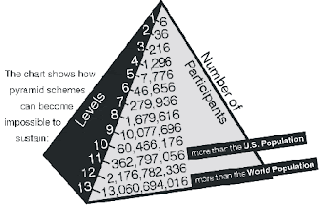
Most people on gut reaction would answer no to such a proposition. So let's go further. In the contra examples to Ponzi schemes provided above it is notable that both pension schemes and equity markets are regulated and that participants presumably know at least some of the risks. So what if Ponzi schemes came complete with prospectuses outlining the risks of participation? If the answer with these amendments is still no, maybe it would be helpful to remind readers that lotteries are essentially Ponzi schemes, though even arguably more extreme as there are fewer 'winners.' Maybe the reader is opposed to investing and/or lotteries altogether. However, for everyone else, it might at this point be tough to come up with reasons why something defined as a completely voluntary fund with complete transparency which promises nothing more than your money back with the possibility of a return 'if you get out early enough' (i.e. win) shouldn't exist.
Parallels can also be drawn to the stock market. IPO investors are more likely to get their money, plus a nice bonus, for their troubles than the later investors whose buying pushes up the price. To people who see little difference between Ponzi schemes and the equity markets anyway, perhaps this similarity is not that striking. Indeed, extreme proponents of such theories might suggest that, like illegal pyramid schemes, stock markets should be shut down. We are certainly not suggesting that however. Indeed, on the contrary, what if we took the other side altogether. What if to be provocative, we suggested that Ponzi schemes, like pension plans and stock markets, should be legal?

Page 14 of the prospectus might look something like this...
Most people on gut reaction would answer no to such a proposition. So let's go further. In the contra examples to Ponzi schemes provided above it is notable that both pension schemes and equity markets are regulated and that participants presumably know at least some of the risks. So what if Ponzi schemes came complete with prospectuses outlining the risks of participation? If the answer with these amendments is still no, maybe it would be helpful to remind readers that lotteries are essentially Ponzi schemes, though even arguably more extreme as there are fewer 'winners.' Maybe the reader is opposed to investing and/or lotteries altogether. However, for everyone else, it might at this point be tough to come up with reasons why something defined as a completely voluntary fund with complete transparency which promises nothing more than your money back with the possibility of a return 'if you get out early enough' (i.e. win) shouldn't exist.
The State of Journalism in the New Year
Regular readers will know that Blawgconomics is a huge fan of The Financial Times and in particular the weekend edition. For anyone who was unable to read the Life & Arts section over this past weekend, we can provide a brief summary of an excellent and thought-provoking piece penned by John Lloyd regarding the state of the field of journalism in an operating environment where transparency and political partisanship have become more aggressive in nature, both in the name of the citizenry.
Lloyd starts from the premise that, until the past year or so, journalism had been on a steady decline for some time. Many would agree with that statement, particularly to the extent that by journalism, we mean more traditional sources. Lloyd continues by stating that 2010 brought a halt and even reversal to this trend by 1) the transformation of journalism into what he calls the 'competing high-decibel political dispute' and 2) the rise of 'total transparency.'
Lloyd argues that the combination of these factors, represented by the takeover of politics in America by media in the first case, and WikiLeaks and the Cable Leaks (the latter much more familiar to those with an interest in English politics) in the second, though they may have increased the power of journalism, have also added moral complexity to debates over both what the public interest is and how it is best served.
Those interested in Lloyd's full article can find it here. Since it is freely available online, aside from the brief synopsis above it isn't necessary to go much further into detail on Lloyd's points. However what would be a fitting tribute to the work itself would be the acknowledgement that, like much good writing, it was very thought-provoking. Therefore, following this paragraph are some general thoughts we had while reading Lloyd. While we will stay away from some of the moral complexities Lloyd addresses, we will then transition from the starting point of the list into some more basic and general ideas on the power of the rising media itself:
Lloyd starts from the premise that, until the past year or so, journalism had been on a steady decline for some time. Many would agree with that statement, particularly to the extent that by journalism, we mean more traditional sources. Lloyd continues by stating that 2010 brought a halt and even reversal to this trend by 1) the transformation of journalism into what he calls the 'competing high-decibel political dispute' and 2) the rise of 'total transparency.'
Lloyd argues that the combination of these factors, represented by the takeover of politics in America by media in the first case, and WikiLeaks and the Cable Leaks (the latter much more familiar to those with an interest in English politics) in the second, though they may have increased the power of journalism, have also added moral complexity to debates over both what the public interest is and how it is best served.
Those interested in Lloyd's full article can find it here. Since it is freely available online, aside from the brief synopsis above it isn't necessary to go much further into detail on Lloyd's points. However what would be a fitting tribute to the work itself would be the acknowledgement that, like much good writing, it was very thought-provoking. Therefore, following this paragraph are some general thoughts we had while reading Lloyd. While we will stay away from some of the moral complexities Lloyd addresses, we will then transition from the starting point of the list into some more basic and general ideas on the power of the rising media itself:
1.08.2011
Snippets...
Welcome to Snippets, Blawgconomics' semi-regular attempt at covering a lot of topics from the worlds of law, economics and politics in a little time. Some would call this lazy; economists prefer the term 'efficient.'
- Let's kick things off this edition with a story that just as well could have been a 'Lawsuit of the Week' posting on its own. Paul Mason, once 'The World's Biggest Man,' is suing the National Health Service of his home nation England for 'letting (him) grow' after physicians only told him to get more exercise in response to his requests for help. Mason claims that any compensation gained from the suit would be used to help others. Presumably, this would not include the average English taxpayer, each one of whom has already contributed some fraction of the 1 million pounds Mason's medical care is estimated to have cost.
- In other British health news, Citigroup analyst Adam Spielman has noted that, at current trends, there may be no smokers left in the realm by 2050. Luckily for Big Tobacco, Asians sadly seem to be picking up the slack.
- In a case worthy of the most intense interest of anyone curious about the intersection of law and economics, the high court of Massachusetts held that two bank foreclosures had been invalid because the banks, in a soupy mess of anonymous collateralized debts, couldn't prove that they owned the mortgages. Though the ruling is only precedential in Massachusetts, it was viewed by many as a test case which, particularly with the result it led to, could be a guide to other judges around the country as additional foreclosure cases inevitably come before courts. Banking indices declined over 2% yesterday as a result of the ruling.
- Let's kick things off this edition with a story that just as well could have been a 'Lawsuit of the Week' posting on its own. Paul Mason, once 'The World's Biggest Man,' is suing the National Health Service of his home nation England for 'letting (him) grow' after physicians only told him to get more exercise in response to his requests for help. Mason claims that any compensation gained from the suit would be used to help others. Presumably, this would not include the average English taxpayer, each one of whom has already contributed some fraction of the 1 million pounds Mason's medical care is estimated to have cost.
- In other British health news, Citigroup analyst Adam Spielman has noted that, at current trends, there may be no smokers left in the realm by 2050. Luckily for Big Tobacco, Asians sadly seem to be picking up the slack.
- In a case worthy of the most intense interest of anyone curious about the intersection of law and economics, the high court of Massachusetts held that two bank foreclosures had been invalid because the banks, in a soupy mess of anonymous collateralized debts, couldn't prove that they owned the mortgages. Though the ruling is only precedential in Massachusetts, it was viewed by many as a test case which, particularly with the result it led to, could be a guide to other judges around the country as additional foreclosure cases inevitably come before courts. Banking indices declined over 2% yesterday as a result of the ruling.
1.07.2011
State Debt Levels
We have been noting a lot of traffic to a past post on state debt levels, indicating that readers might be looking for resources and statistics on the topic. Though we updated the earlier post, we thought it might additionally be helpful to do a partial re-posting of the old material today to keep everything close to hand:
Here is a CNN Money page with an interactive map which allows users to see per capita debt levels, while readers can visit the article which linked to the map here. Meanwhile, this Forbes map, while a bit more dated, provides slightly more information out of the same format. Here is an interesting page with statistics as well as functionality allowing users to make their own charts. Finally, for those with an economist's dismal sense of humor, we stumbled across this Boston Fed report from 1997 with summaries of the economic status of each the states of the New England region. The real laughs come on pages 5, 6 and 7 where readers can read about budget surpluses in places like Massachusetts and Connecticut.
Here is a CNN Money page with an interactive map which allows users to see per capita debt levels, while readers can visit the article which linked to the map here. Meanwhile, this Forbes map, while a bit more dated, provides slightly more information out of the same format. Here is an interesting page with statistics as well as functionality allowing users to make their own charts. Finally, for those with an economist's dismal sense of humor, we stumbled across this Boston Fed report from 1997 with summaries of the economic status of each the states of the New England region. The real laughs come on pages 5, 6 and 7 where readers can read about budget surpluses in places like Massachusetts and Connecticut.
The List: The Top 50 Blawgs You Aren't Reading Yet
The folks over at Legal Studies Blog have compiled a list of 50 otherwise 'excellent' blawgs which nonetheless haven't quite hit Above the Law status yet. Happily for us, anyone visiting this post only has 49 sites left to visit as Blawgconomics came in at number 8. The author did a great job diversifying, leaving the curious free to explore everything from lobbyist blawgs to student blawgs to blawgs focused on just about any esoteric area in the practice of law one could imagine. Enjoy, and many heartfelt thanks to Legal Studies Blog for their support.
1.04.2011
Search for New National Economic Council Director Heating Up
Reports suggest that the Obama administration is coming closer to settling on its pick to head one of the most important bodies in Washington, the National Economic Council. Notably, the position of top economic advisor to the President is particularly visible and important heading into an election cycle that will see the economy being the foremost topic on the minds of most voters.
Experience on both Capitol Hill and Wall Street will be important factors in the final decision of picking Larry Summers' successor, and apparent frontrunner Gene Sperling has both. These factors, in addition to recent experience negotiating the tax bill with top Republicans, make Sperling a positive, as well as a practical, pick. Reuters has more details, as well as details on other contenders, here.
Experience on both Capitol Hill and Wall Street will be important factors in the final decision of picking Larry Summers' successor, and apparent frontrunner Gene Sperling has both. These factors, in addition to recent experience negotiating the tax bill with top Republicans, make Sperling a positive, as well as a practical, pick. Reuters has more details, as well as details on other contenders, here.
Lawsuit of the Week...
Though this edition of Lawsuit of the Week runs the risk of being called 'Hollywood' we think you will agree that the following story is nonetheless a very worthy recipient of the honor. With both big and not-so-big movie stars as well as associates with names worthy of James Bond villian status (we will let you figure out on your own who we are referencing with these descriptions below) caught up in corporate intrigue after a recent disaster, it almost feels as if a mash-up of a B-film from the nineties with a destined-to-fail summer blockbuster.
However, allow us to dispense with the pleasantries. For those who haven't heard, Stephen Baldwin and his friend Spyridon Contogouris are suing Kevin Costner for misleading them over the status of the chemical company they all had ownership stakes in. The company, started by Costner, had developed a technology which separated water from oil. For those who have been on a space station or under a rock for the past 12 months or so, this took on particular relevance when the BP disaster in the Gulf of Mexico occured as there was suddenly much more demand for such a process than there had been previously. Baldwin and Contogouris were apparently involved as equity partners and in a marketing/matchmaking capacity.
Oh yes, we almost forgot...there was a failed venture which had been developed to produce a documentary about the disaster that is involved in the suit as well. Contogouris is suing for $10.64 million in damages while Baldwin claims $3.8 million, both on claims of securities misrepresentation and fraud. Reuters has more details, including a description of the almost shockingly unforeseeable breakdown in relations between the parties here.
However, allow us to dispense with the pleasantries. For those who haven't heard, Stephen Baldwin and his friend Spyridon Contogouris are suing Kevin Costner for misleading them over the status of the chemical company they all had ownership stakes in. The company, started by Costner, had developed a technology which separated water from oil. For those who have been on a space station or under a rock for the past 12 months or so, this took on particular relevance when the BP disaster in the Gulf of Mexico occured as there was suddenly much more demand for such a process than there had been previously. Baldwin and Contogouris were apparently involved as equity partners and in a marketing/matchmaking capacity.
Oh yes, we almost forgot...there was a failed venture which had been developed to produce a documentary about the disaster that is involved in the suit as well. Contogouris is suing for $10.64 million in damages while Baldwin claims $3.8 million, both on claims of securities misrepresentation and fraud. Reuters has more details, including a description of the almost shockingly unforeseeable breakdown in relations between the parties here.
1.03.2011
A Fanciful Guide for New Lawmakers
With a new Congress being sworn in later this week, it seems an opportune time to say a few words about a topic which has been on my mind for some time and which recent events have only made more relevant. Though the idea is perhaps a fanciful one, and indeed it is nearly inconceivable as a practical matter, it does give one food for thought, and that is what Blawgconomics is all about. The idea is simply the following question; if lawmakers could start from scratch, if they could scrap all existing laws, every judicial precedent, every tradition and perhaps if they could even take guidance not from the Constitution, but from moral and societal ideals of the day, what would the legal system and structure of the nation look like?
Presumably there would need to be some basis for the establishment of laws in general, so perhaps a new overarching governance document would be written. In addition to pronouns changing and something like the current Bill of Rights becoming part and parcel of the actual document itself, one might wonder how hot button structural topics such as first amendment or religious rights might be handled. Perhaps technology would be accounted for in a meaningful way that was just not possible for the Founding Fathers in their time. Maybe there would be some provisions making it easier/more possible for third parties to gain traction.
Aside from the more foundational and structural issues, one could find themselves getting a bit more creative on specific contemporary issues. Without existing legislation, norms and traditions shaping it, would the healthcare legislation have ended up differently? Would the government have the ability to pass the type of stimulus legislation is just did? Would gun rights be so sacred? Would the death penalty exist? How might abortions be handled? How would international relations be impacted? For example, would we be more isolationist as a rule?
Presumably there would need to be some basis for the establishment of laws in general, so perhaps a new overarching governance document would be written. In addition to pronouns changing and something like the current Bill of Rights becoming part and parcel of the actual document itself, one might wonder how hot button structural topics such as first amendment or religious rights might be handled. Perhaps technology would be accounted for in a meaningful way that was just not possible for the Founding Fathers in their time. Maybe there would be some provisions making it easier/more possible for third parties to gain traction.
Aside from the more foundational and structural issues, one could find themselves getting a bit more creative on specific contemporary issues. Without existing legislation, norms and traditions shaping it, would the healthcare legislation have ended up differently? Would the government have the ability to pass the type of stimulus legislation is just did? Would gun rights be so sacred? Would the death penalty exist? How might abortions be handled? How would international relations be impacted? For example, would we be more isolationist as a rule?
A brief tax analysis on REITs and Renewables
I recently came across a Deloitte white paper named The changing environment of R&R (REITs and Renewables) (Jessica Duran and Charles Temkin, 2010, .pdf available here) in which the authors have summarized the means by which REITs may integrate renewable energy infrastructure into their corporate form as of today. Before describing how some of the common leaseback arrangements are structured, however, the authors take some time to discuss the various current tax regimes and how they fail the REIT sector. For as most renewable energy insiders will know, the game of identifying how REITs may 'go green' is almost always more a discussion about restrictions than opportunities. As Duran and Temkin note,
While the authors note the common problem of the tax issues REITs will confront in their green initiatives, the real benefit of their work is where they point out some creative avenues by which future successes may come. For example, the discussion of performance based incentives provides an example of what could be accomplished by a REIT team with a bit of creativity, while the brief sections on Treasury authority and legislative proposals provide a solid background on some more traditional routes with potential and echo some of the work we have posted on this site in the past.
There already exists a broad menu of federal, state, local and public utility financial incentives to encourage renewable energy and accelerate capital investment. Among these are fast track permitting, rebates, green power purchasing programs, tax deductions, credits and grants. However, REITs with a sustainability initiative will confront unique tax issues and a regulatory regime that may limit their ability to avail themselves of the benefits extended to non-REIT commercial property owners.
While the authors note the common problem of the tax issues REITs will confront in their green initiatives, the real benefit of their work is where they point out some creative avenues by which future successes may come. For example, the discussion of performance based incentives provides an example of what could be accomplished by a REIT team with a bit of creativity, while the brief sections on Treasury authority and legislative proposals provide a solid background on some more traditional routes with potential and echo some of the work we have posted on this site in the past.
Subscribe to:
Posts (Atom)